


You’ve just invested in a facelift — one of the most transformative procedures in facial rejuvenation — and now you’re wondering: when can you get back to your regular hair coloring routine? It’s one of the most common post-op questions patients ask, and for good reason. Hair color appointments are a regular part of most people’s self-care routines, and the timing matters more than you might think.
The short answer is that most patients should wait at least 4 to 6 weeks after a facelift before coloring their hair. But the full picture is more nuanced — and understanding why this waiting period exists will help you protect your results and heal with confidence. If you’re still in the planning phase, our facelift recovery timeline guide is a great place to start.
Why You Shouldn’t Rush Back to the Hair Salon
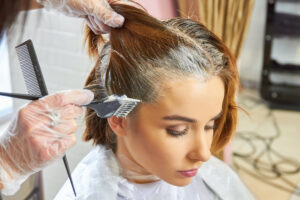
After a facelift, your scalp and surrounding skin are in an active healing state. Facelift incisions typically run along the hairline and around the ears — which places them in very close proximity to where hair color products are applied and where the scalp experiences chemical contact.
Here’s what makes rushing back to the salon risky:
Chemical irritation to healing incisions. Hair dye contains chemicals such as hydrogen peroxide and ammonia that can penetrate compromised skin. During the early weeks of recovery, the incision sites are not fully closed or healed, making them vulnerable to chemical irritation, inflammation, and in some cases, delayed wound healing.
Scalp sensitivity and numbness. As Dr. Peter Lee, Founder and Chief Surgeon of Wave Plastic Surgery, explains in his surgical education courses, patients typically experience temporary decreased sensation of the face and scalp for one to two months following a facelift. This numbness is important to keep in mind — because you may not feel burning or irritation that would otherwise signal a problem. The chemicals could be causing damage without you realizing it.
Risk of infection. Open or recently healed incisions are susceptible to infection. Hair coloring environments (salons) and the chemicals themselves introduce unnecessary risk during the critical healing window.
Impact on scar quality. Wave’s surgical team emphasizes that how well a scar heals is a top priority in facelift recovery. Chemical exposure to scalp incisions during the healing phase can compromise scar appearance and slow the fading process.
The General Guideline: 4 to 6 Weeks Minimum
Most board-certified plastic surgeons recommend waiting a minimum of 4 to 6 weeks after a facelift before coloring your hair. This aligns with the point at which the superficial incisions have healed, swelling has significantly reduced, and the skin has regained enough integrity to tolerate chemical contact.
Some surgeons extend this recommendation to 6 to 8 weeks, particularly for patients who had a more extensive procedure such as a High SMAS face and neck lift — which involves deeper tissue repositioning, a longer incision pattern, and a more comprehensive recovery. If you’re unsure which type of facelift you had, ask your surgeon explicitly at your follow-up appointment.
It’s worth noting that the 4 to 6 week window is a minimum, not a guarantee. Every patient heals differently, and your surgeon’s clearance should always take precedence over any general guideline.
Does the Type of Facelift Affect the Timeline?
Yes — the extent of your procedure plays a meaningful role in your hair coloring timeline. Here’s a general breakdown:
Mini Facelift / Wave Lift™: Shorter incisions and less extensive tissue work generally mean faster recovery. Most patients see about 80% of their swelling resolve within two weeks. Hair coloring is typically cleared around the 4-week mark, pending incision healing. Learn more about the Wave Lift™ and what makes it a popular choice for patients not yet ready for a full procedure.
Standard or Full Facelift / Cure Lift XL™: With more extensive incisions and deeper work, a 6-week minimum is more appropriate before reintroducing chemical hair treatments.
High SMAS Face & Neck Lift: This is the most comprehensive facelift category, addressing the deepest structural layers of the face and neck. Recovery typically takes about three weeks before 80% of swelling resolves, and full healing continues over six months. Hair coloring should be discussed with your surgeon at the 6-week follow-up and may be cleared closer to the 8-week mark.
Endoscopic Facelift: Because this technique uses smaller incisions — often placed within the hairline — extra caution is warranted. The incisions sit directly in the path of hair color application. Most patients should wait a full 6 weeks, and it’s critical to let the colorist know exactly where your incisions are.
What About a Thread Lift?
Thread lifts have a shorter and more forgiving recovery compared to surgical facelifts. At Wave, our team advises patients recovering from thread lift procedures to avoid hair color treatments and perms for approximately one month after their procedure. This protects the thread entry points as they integrate with the surrounding tissue and allows facial swelling to fully resolve before exposing the area to chemicals.
Curious about how thread lifts compare to surgical options? Our facelift vs. thread lift comparison breaks down the differences in recovery, results, and longevity.
Recovery Week-by-Week: What’s Happening to Your Scalp
Understanding your body’s healing process helps clarify why the waiting period isn’t arbitrary.
Days 1–3: A head bandage is placed after surgery and removed around day two. Patients can typically wash their hair and shower after this point — but this is gentle washing with mild shampoo only, not chemical treatments.
Week 1–2: Stitches are removed around 10–14 days post-op. The incisions are closed but not fully healed. Swelling and bruising are most pronounced. The scalp feels tight and sensitive (or numb). This is absolutely not the time for hair color.
Weeks 3–4: About 80% of swelling has resolved for most patients. The skin looks significantly more normal, and patients often feel ready to resume more activities. However, the incision sites are still in an early remodeling phase — scar tissue is forming and strengthening. Hair coloring is not yet recommended.
Weeks 4–6: For mini facelift patients with well-healed incisions, a surgeon may clear hair coloring around this point. For more extensive procedures, this is typically the earliest point to ask your surgeon — not necessarily to act.
6–8 Weeks and Beyond: Most patients receive clearance to resume hair coloring after their 6-week follow-up, provided healing is progressing well. Scars continue to lighten and mature for up to six months, which is normal.
If you want a deeper look at what each week of facelift recovery looks like, visit our detailed facelift recovery timeline.
Tips for Hair Care During Facelift Recovery
Just because you’re waiting on color doesn’t mean your hair has to suffer. Here are some practical ways to manage your hair during the healing period:
Time your color appointment strategically before surgery. Many patients schedule a fresh color treatment 1–2 weeks before their facelift so they’re not left with significant root growth or color fading during the recovery window. This is one of the most effective ways to minimize inconvenience.
Use root touch-up products (carefully). Brush-on or spray root concealers are available at most beauty supply stores and can help camouflage regrowth without applying chemicals to the scalp. Apply carefully and avoid direct contact with incision areas.
Gentle shampoo and conditioning only. Stick to mild, fragrance-free shampoos during the healing period. Avoid vigorous scrubbing of the scalp near incision sites.
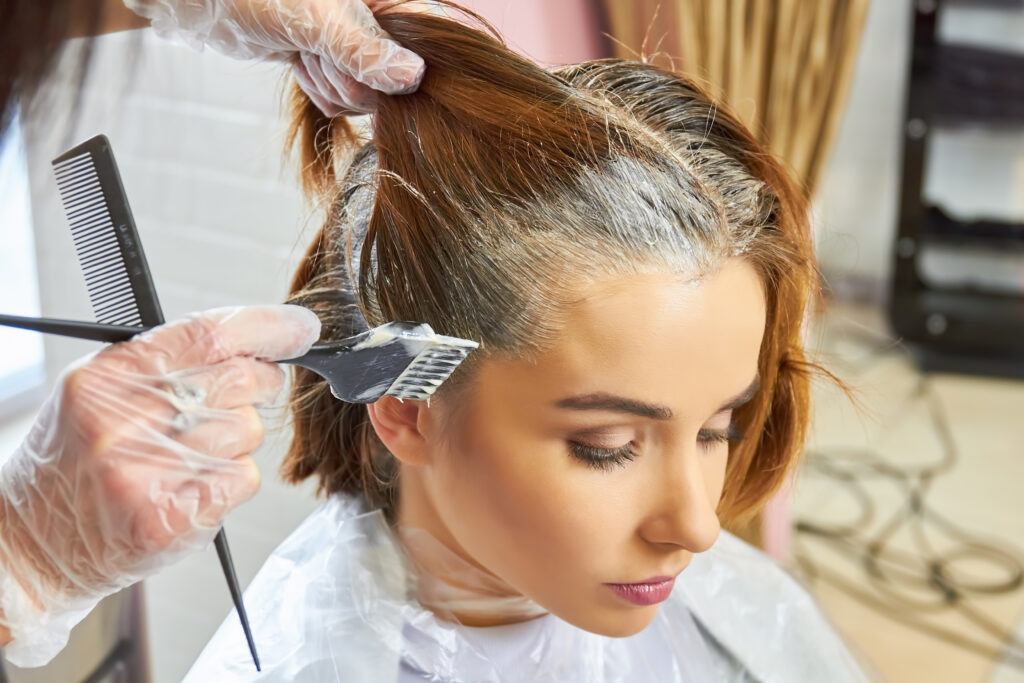
Communicate with your colorist. When you do return to the salon, be upfront about your surgery and recovery. A skilled colorist can use foil techniques or highlight methods that keep chemical contact away from the hairline and scalp incisions.
Ask about semi-permanent options. Semi-permanent or demi-permanent hair color doesn’t use the same high levels of peroxide as permanent color, which may make them a gentler first step when returning to color after your surgeon’s clearance. Discuss with your colorist.
When to Call Your Surgeon
Contact your surgeon’s office if you experience any of the following after returning to hair coloring:
- Burning, stinging, or unusual pain at incision sites during or after color application
- Redness, warmth, or swelling around a healed incision
- Any signs of wound opening, oozing, or skin irritation near a scar
- Unexpected hair loss in the area of surgical incisions
These symptoms don’t necessarily indicate a serious problem, but they warrant a call to your care team for evaluation.
Planning Your Facelift: What to Consider
If you’re still in the consideration phase — not yet post-op — this is the perfect time to plan ahead. Discussing your hair coloring habits and schedule with your surgeon during your consultation allows them to advise you appropriately based on your specific procedure type and healing history.
At Wave Plastic Surgery, our surgical team takes a highly individualized approach to facelift surgery and post-operative care. Whether you’re considering the Wave Lift™, the High SMAS Face & Neck Lift, or exploring whether a mini facelift vs. full facelift is right for you, recovery planning starts at your very first consultation.
Wondering if you’re a candidate? Our guide on signs you might be ready for a facelift can help you start the conversation.
References
- American Society of Plastic Surgeons. Facelift Surgery. https://www.plasticsurgery.org/cosmetic-procedures/facelift
- American Board of Facial Plastic and Reconstructive Surgery. Patient Education: Facelift. https://www.abfprs.org/patient-education/
- National Library of Medicine / NIH. Wound Healing and Chemical Irritants. https://www.ncbi.nlm.nih.gov/books/NBK537324/
- U.S. Food & Drug Administration. Hair Dye Products: Safety Information. https://www.fda.gov/cosmetics/cosmetic-products/hair-dye-products
Schedule Your Facelift Consultation at Wave Plastic Surgery
Ready to explore your facelift options — or have questions about recovery from a procedure you’re already planning? Our team is here to guide you every step of the way. Call us at (888) 674-3001 to schedule your personalized consultation at one of our locations in Los Angeles, Orange County, Arcadia, Rowland Heights, or San Francisco. We’ll walk you through what to expect before, during, and after surgery — including how to plan every detail of your recovery.