

If you’ve been researching facial rejuvenation options, you’ve likely come across the mini facelift — a less invasive alternative to a traditional facelift that appeals to patients who want meaningful results without an extended recovery. But one of the most common questions patients ask before committing to any procedure is: how long will this actually last? The answer depends on several factors, from surgical technique to how well you care for your skin after recovery.
This guide breaks down everything you need to know about mini facelift longevity, what influences how long your results hold, and how innovations like the Wave Lift can maximize the durability of your outcome.
What Is a Mini Facelift?
Before diving into longevity, it helps to understand what a mini facelift actually does — and doesn’t do. A mini facelift is a shortened, less extensive version of a traditional facelift. Rather than addressing the full face and neck, it focuses primarily on the lower face: the jowls, the lower cheeks, and the area around the mouth and chin.
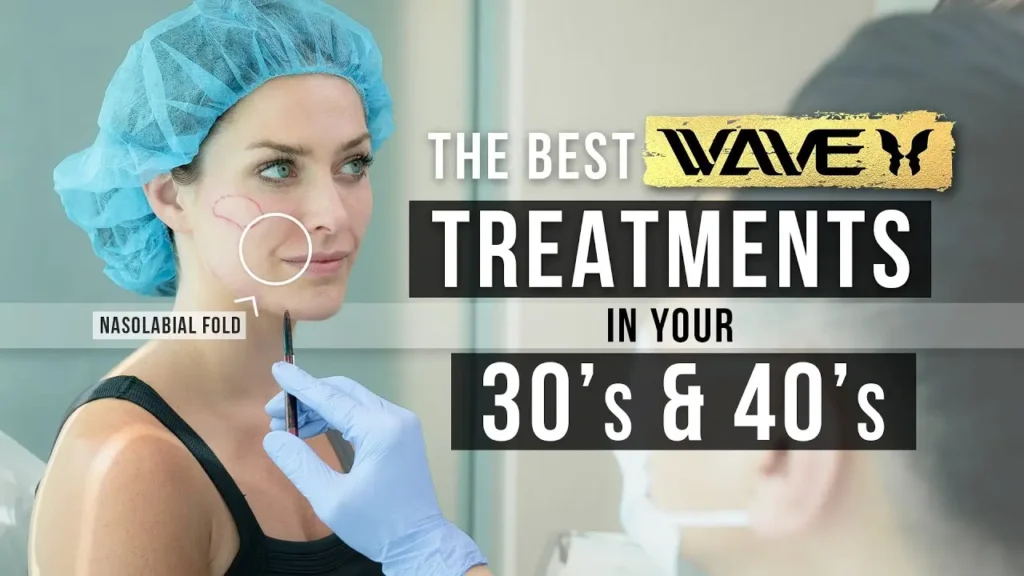
Mini facelift candidates are typically patients in their 30s, 40s, and early 50s who are showing early to moderate signs of facial aging — not patients who need the comprehensive correction a full face and neck lift provides. It’s a targeted procedure for targeted concerns, and understanding that distinction is key to having realistic expectations about how long results will last.
For those wondering whether they’re a good fit, our blog post on signs you might be ready for a facelift offers a helpful breakdown.
How Long Does a Mini Facelift Last?
Most patients can expect a mini facelift to last somewhere in the range of 3 to 7 years, though this range varies considerably depending on surgical approach, patient age, skin quality, and post-procedure habits. It’s important to note that this is not a “wear off” situation — rather, natural aging continues after surgery, gradually diminishing results over time.
Some patients report visible improvement for close to a decade, while others notice the effects softening sooner. The most significant factor in determining where your results fall within that range comes down to technique.
Why Surgical Technique Has the Biggest Impact on Longevity
Not all mini facelifts are created equal. The durability of results is heavily influenced by how the procedure is performed — specifically, whether the surgeon works only at the skin level or also addresses the deeper muscular layer beneath it.
When tension is placed solely on the skin, results fade faster. Skin is elastic; it stretches and relaxes over time, meaning any lift created by pulling only at the surface will gradually give way. Conversely, when the underlying muscle (known as the SMAS — the superficial musculoaponeurotic system) is properly released and repositioned before lifting, the results are significantly more durable.
As Dr. Peter Lee, founder and chief surgeon at Wave Plastic Surgery, explains: “The key to any type of lifting in the face is not how much you actually pull and lift, but it’s about how much you really release that muscle before you pull. When you forcibly pull on something, there’s going to be a lot of resistance. And if there’s a lot of resistance, the tendency is that as time goes by, it’s going to fall back much quicker — so the result won’t last as long.”
This philosophy of releasing attachments before lifting is central to Wave’s surgical approach and is one of the primary reasons patients achieve longer-lasting, more natural-looking outcomes.
The Wave Lift: Wave’s Endoscopic Mini Facelift Approach
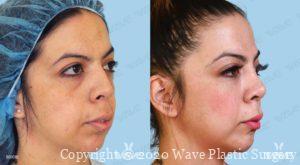
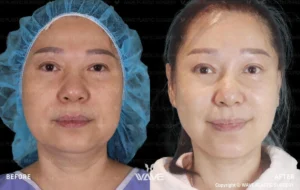
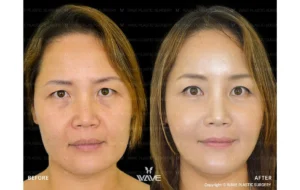
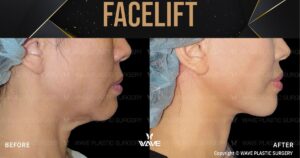
At Wave Plastic Surgery, the Wave Lift is the practice’s signature approach to the mini facelift — performed endoscopically using a small camera inserted through limited incisions in the temple region. The endoscope allows the surgical team to visualize the deep tissue layers with remarkable precision, enabling thorough release of muscular attachments before any lifting takes place.
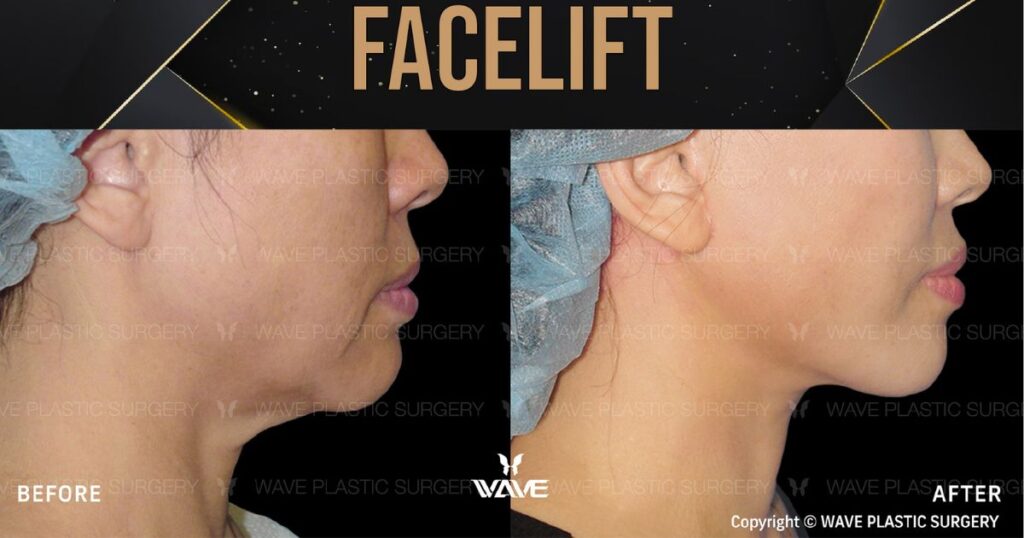
The procedure typically takes about 1.5 hours and addresses the nasolabial folds, jowls, hollowness in the cheek region, and drooping at the corners of the mouth. Because the technique works at the muscular level — not just the skin — the results are meaningfully more durable than traditional skin-tension approaches.
Dr. Lee notes that the Wave Lift is designed to achieve three outcomes: naturalness, a definitive result, and longevity — “not one of those results that’s gonna last one or two years, but really shooting for seven to ten years.”
You can compare the Wave Lift to other options by exploring our breakdowns of the mini deep plane facelift, lunchtime facelift, and weekend facelift options.
Mini Facelift vs. Full Facelift: How Do Results Compare?
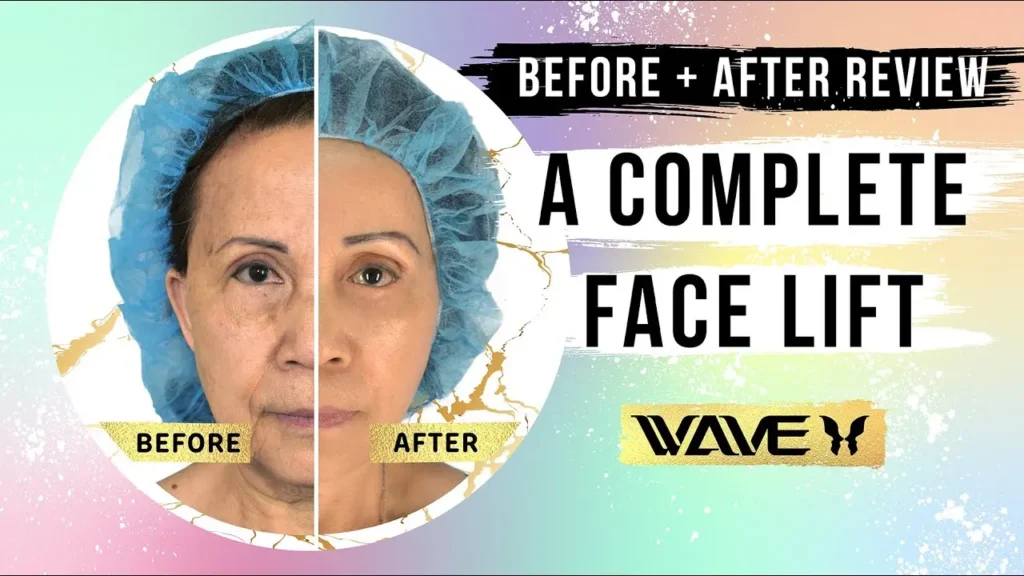
It’s a fair question to ask: if a mini facelift lasts 3–7 years, how does that compare to a full facelift? A traditional face and neck lift — particularly a High SMAS technique — is generally considered the gold standard for longevity. Results from a comprehensive face and neck lift can often last 10 years or more, and the correction achieved is far more extensive.
That said, a full facelift is not the right choice for every patient. Someone in their early 40s with mild jowling and good skin elasticity may be far better served by a properly executed mini facelift than by undergoing a more aggressive procedure they don’t yet need.
Understanding the difference can help you make the right call. Our article on the cost of a mini facelift vs. full facelift provides additional context on how these procedures compare across multiple dimensions. For those curious about more advanced techniques, what is a High SMAS facelift explains Wave’s approach to comprehensive face and neck lifting.
Factors That Affect How Long Your Results Last
Beyond surgical technique, a number of patient-specific and lifestyle factors influence mini facelift longevity.
Age at the time of surgery. Younger patients in their late 30s to early 50s with good skin elasticity tend to see longer-lasting results than older patients with more advanced skin laxity. However, the right age for a facelift depends more on your individual condition than a number — read more in our post on what’s the best age for a facelift.
Skin quality and elasticity. Patients with good baseline skin tone and elasticity retain results longer. Sun damage, tobacco use, and chronic dehydration all compromise skin quality and can accelerate post-surgical aging.
Sun protection habits. UV exposure is one of the leading accelerators of skin aging. Consistent, daily sunscreen use after your procedure significantly extends how long your results remain visible.
Smoking. Smoking impairs circulation, delays wound healing, and dramatically accelerates skin aging. Most surgeons require patients to stop smoking well before and after surgery — and continuing to smoke post-procedure will shorten your results considerably.
Weight stability. Significant weight fluctuations can impact facial volume and skin tension, potentially affecting how your results hold over time.
Skincare and maintenance. Consistent use of medical-grade skincare products, professional skin treatments, and periodic non-surgical maintenance (such as injectables or skin tightening) can help preserve and extend your surgical results.
Extending Your Results: Non-Surgical Maintenance
One of the most effective strategies for getting the most from your mini facelift is complementing it with non-surgical maintenance treatments in the years following surgery. Many patients incorporate periodic Botox or dermal fillers to address areas that fall outside the scope of a mini facelift — such as forehead lines, crow’s feet, and volume loss in the temples or under-eye area.
Skin tightening technologies like Morpheus8, Ultherapy, or FaceTite can also help maintain skin quality between procedures. For patients who want comprehensive non-surgical support, our non-surgical facelift options offer a range of complementary treatments.
For context on how surgical and non-surgical approaches stack up, our comparison of surgical vs. non-surgical lifts and facelift vs. thread lift are worth reviewing before making any decisions.
What to Expect During Recovery
Recovery from a mini facelift is notably faster than a traditional facelift. Most patients experience 80% reduction in swelling within about two weeks, with stitches typically removed at the 10–14 day mark. There is minimal pain associated with the procedure, though patients may notice some tightness and temporary decreased facial sensation for up to two months.
The limited incision approach also means scarring is minimal and well-concealed within the hairline and along the natural contours of the ear. Most patients are comfortable being seen in public with light makeup coverage within 2–3 weeks post-procedure.
For a detailed look at what the healing process involves, our facelift recovery timeline article and guide on how long it takes to recover from a facelift provide helpful week-by-week information.
Mini Facelift Cost Considerations
Mini facelift pricing varies significantly based on the complexity of the procedure, the surgeon’s level of expertise and experience, geographic location, and whether the technique involves advanced endoscopic technology. Surgeon’s fees for a mini facelift typically range from $5,000 to $18,000 or more — and it’s important to note that these figures represent surgeon fees only; operating room and anesthesia fees are generally not included in quoted prices.
As a general rule, the more experienced and specialized the surgeon, the higher the price point — and with a procedure as technique-sensitive as a mini facelift, surgeon skill has a direct impact on how natural and long-lasting your results will be. Choosing a surgeon based primarily on cost is a common pitfall that can lead to disappointment with both outcomes and longevity.
Wave Plastic Surgery also offers a price match guarantee for qualifying procedures, as well as flexible financing options to help make surgery more accessible. For a broader breakdown of cost factors, visit our page on how much a facelift costs.
Why Choose Wave Plastic Surgery for Your Mini Facelift
Wave Plastic Surgery is home to a team of board-certified plastic surgeons with deep specialization in facial rejuvenation. Dr. Peter Lee, the founder and chief surgeon, is an internationally recognized expert in endoscopic plastic surgery and holds the distinction of being an Advanced ENDOTINE Bioskills Surgeon Educator and Trainer — one of only a small number of surgeons in the world to hold this credential. Dr. Lee regularly travels internationally to train other surgeons in advanced endoscopic techniques.
With surgical centers across Los Angeles, Orange County, Arcadia, Rowland Heights, and San Francisco, Wave offers patients access to world-class surgical expertise across California. You can view real patient transformations in our before and after gallery and read more about what makes our team distinctive on our meet the doctors page.
References
- American Society of Plastic Surgeons. Facelift Surgery Guide. https://www.plasticsurgery.org/cosmetic-procedures/facelift
- American Board of Plastic Surgery. Maintaining Certification. https://www.abplsurg.org
- U.S. National Library of Medicine, National Institutes of Health. Facelift (Rhytidectomy). https://www.ncbi.nlm.nih.gov/books/NBK547710/
- Aesthetic Society. Facelift: What You Should Know. https://www.theaestheticsociety.org/procedures/face/facelift
Schedule Your Personalized Consultation
Ready to find out if a mini facelift is right for you? The surgeons at Wave Plastic Surgery in Los Angeles and Orange County will evaluate your unique facial anatomy, discuss your goals, and help you understand which approach will deliver the most natural, long-lasting results. Call us at (888) 674-3001 to schedule your consultation today.